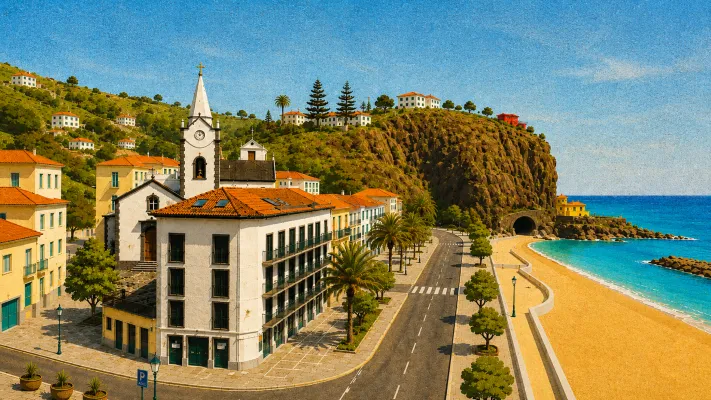
Island Living in the Mid-Atlantic: Madeira and the Azores
When people think about moving to Portugal, they almost always picture the mainland. They debate Porto versus the Algarve. But out in the middle of the Atlantic sit two autonomous archipelagos that offer some of the most breathtaking, unique lifestyles anywhere on the planet: Madeira and the Azores.
Moving to the islands isn’t just a change of address; it’s a complete lifestyle pivot. These aren’t sleepy, disconnected vacation outposts — they’re fully integrated, modern regions of Portugal and the European Union, with world-class infrastructure, incredible safety, and a deeply welcoming local culture.
However, treating Madeira and the Azores as the same would be a mistake. While both feature dramatic volcanic landscapes and stunning ocean views, they have completely different energies, climates, and communities.
1. Madeira: The Subtropical Cosmopolitan Haven
Often called the “Island of Eternal Spring,” Madeira sits closer to the coast of North Africa than it does to mainland Europe. It’s a dramatic, vertical island where towering emerald mountains drop straight into a deep blue ocean, covered in terraced vineyards and exotic flowers.
Funchal: The Island Capital
Funchal is a spectacular city. It manages to feel like a sophisticated, historic European capital while being surrounded by banana trees and sea cliffs. It features an old town, outstanding gastronomy, pristine botanical gardens, and a highly active cultural calendar.
The Vibe: Vibrant, upscale, warm, and highly international.
Ponta do Sol: Just west of Funchal, this sunny coastal town has become a hub for digital nomads, with coworking spaces, fiber internet, and a growing international community — all with a subtropical backdrop.
Who it’s for: Expats and remote workers who want a dramatic tropical backdrop but refuse to compromise on city infrastructure. If you need high-speed fiber internet, upscale dining, modern private hospitals, and a buzzing English-speaking international community, Funchal is a dream.
2. The Azores: The Raw, Wild Eden
Located further north and deeper into the Atlantic, the Azores is a cluster of nine distinct islands. If Madeira is a manicured, tropical paradise, the Azores is raw, untamed nature at its finest — massive crater lakes, steaming geothermal hot springs, rolling green pastures dotted with cows, and black sand beaches. It feels like a cross between Hawaii, Iceland, and the coast of Ireland.
The Main Hubs
São Miguel (Ponta Delgada): The largest and most populated island. Ponta Delgada is a charming, historic port city with excellent restaurants, a university, and solid infrastructure. It serves as the main gateway to the rest of the archipelago.
Terceira (Angra do Heroísmo): Famous for its beautiful UNESCO-listed historical city filled with color.
Faial (Horta): With its famous marina, Faial has been a legendary stopover for transatlantic sailors for centuries, giving it a surprisingly cosmopolitan, seafaring vibe.
Who it’s for: True nature purists, adventurers, hikers, and those looking for an off-the-beaten-path, slow-paced lifestyle — mornings in natural hot springs, afternoons whale watching, entirely away from the pressures of modern commercialism.
Island Realities
Microclimates
Both archipelagos are defined by intense microclimates. Because of the massive volcanic mountains, the weather can change completely in a matter of kilometers. In Madeira, it can be a crisp, misty afternoon up in the high pine forests of Santo da Serra, while down on the coast in Ribeira Brava, people are sunbathing in 75°F weather. In the Azores, locals joke that you can experience all four seasons in a single afternoon — you learn to always carry a light rain jacket and a pair of sunglasses.
Island Time & Logistics
When you live in the mid-Atlantic, you have to embrace a slower, more adaptable mindset. While both regions have excellent modern supermarkets, airports, and shipping ports, certain specialized goods or online deliveries can take a few extra days compared to Lisbon or Porto. Flights can occasionally be delayed by Atlantic weather fronts. For most who move here, this slight isolation is considered a feature, not a bug — it preserves the safety, tranquility, and untouched charm of the communities.
Business and Tax Considerations
Both island regions enjoy economic autonomy. Madeira, in particular, operates the CINM (Centro Internacional de Negócios da Madeira) — Madeira’s International Business Centre. This is a special economic zone that offers reduced corporate tax rates for companies that register and operate through the center, creating jobs on the island.
A few important clarifications for Americans: the CINM is designed for companies, not for individual tax residents. You cannot simply move to Madeira and pay reduced personal income taxes through the CINM. The program has specific eligibility requirements, substance rules (your business must have real operations and employees on the island), and activity restrictions. If you’re an entrepreneur or tech founder considering structuring a European entity, it’s worth a conversation with our cross-border tax advisor to see whether the CINM fits your business.
Separately, both Madeira and the Azores offer slightly lower VAT rates and some regional tax incentives that do benefit individual residents, though the specifics change periodically. Your tax advisor can walk you through what’s currently in effect.
Portugal’s islands offer a profound alternative to mainland living. Whether you choose the warm, sophisticated streets of Funchal or the wild, volcanic sanctuaries of the Azores, you’re choosing a life intimately tied to the ocean and the land — island living at its finest.
Drawn to the islands? Let’s talk about which archipelago — and which island — fits the life you’re building.
