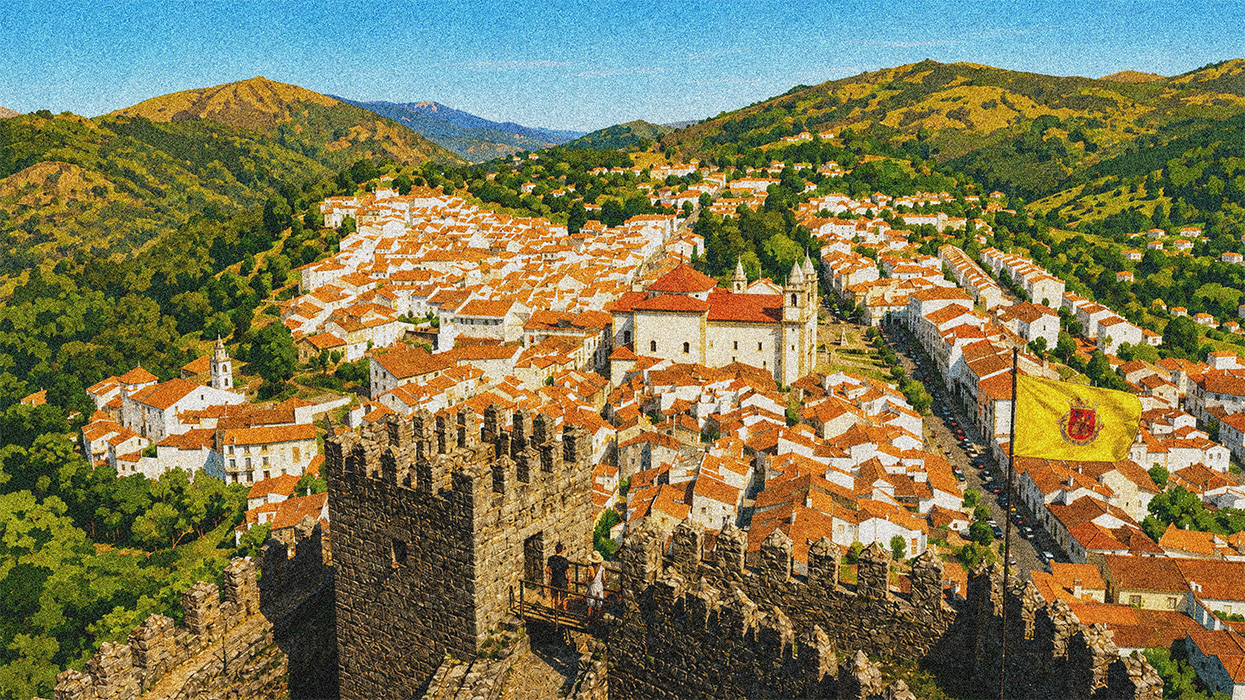
Marvão and the Alto Alentejo Border
There’s a moment, driving through the rolling plains of the upper Alentejo, when you round a bend and see Marvão for the first time. A walled medieval village perched on the very top of a granite peak, silhouetted against the sky, looking like someone carved a town into the clouds and forgot to take it down. It’s one of the most dramatic sights in all of Portugal, and almost no Americans have ever heard of it.
The Alto Alentejo border region — the strip of land between the Serra de São Mamede natural park and the Spanish frontier — is Portugal at its most hidden. There are no international flights nearby, no beach resorts, no golf courses, no expat infrastructure of any kind. What there is: medieval architecture that takes your breath away, thermal springs that have been healing people since Roman times, a natural park teeming with wildlife, and property prices so low they seem like a typographical error.
Marvão: The Fortress in the Sky
Marvão sits at 862 meters, enclosed within 13th-century walls that have survived every war, earthquake, and political upheaval the Iberian Peninsula has produced. The views from the castle ramparts are extraordinary — on a clear day you can see all the way to Spain, across an endless expanse of plains, olive groves, and cork oak forests.
Inside the walls, the village is a single, winding main street of whitewashed houses with granite door frames, tiny plazas with potted geraniums, and a silence so deep you can hear your own footsteps echoing off the stone. The population is small — a few hundred permanent residents — and the atmosphere is one of profound, unhurried calm. A handful of small hotels and guesthouses have opened in recent years (including a new Hotel Museu in 2026), bringing a quiet stream of cultural tourism without disturbing the village’s essential character.
The Vibe: Suspended in time. Medieval without being a museum. Quiet without being abandoned.
Who it’s for: Writers, artists, retirees, and remote workers who want the most dramatic setting in Portugal and don’t need anything beyond stone walls, infinite views, and a good internet connection.
Castelo de Vide: The Sintra of the Alentejo
Just 10 kilometers from Marvão, Castelo de Vide is the yin to Marvão’s yang. Where Marvão is a fortress on a peak, Castelo de Vide is a spa town on a gentle slope — known for its therapeutic spring waters, its Gothic fountains, and one of the best-preserved medieval Jewish quarters (Judiaria) in Portugal.
With a population of around 3,000, Castelo de Vide has significantly more daily infrastructure than Marvão: a small hospital, pharmacies, supermarkets, schools, banks, and a selection of genuinely good restaurants. The town has a strong civic identity and an active cultural calendar. The Saturday market is a real social institution — local farmers, cheesemakers, and artisans setting up beneath the castle walls. Locals call it the “Sintra of the Alentejo,” and while the comparison is imperfect, the spirit — a beautiful, historic hill town with a microclimate softer than its surroundings — is apt.
The Vibe: Gentle, welcoming, civic-minded, and quietly sophisticated.
Who it’s for: Anyone who wants the Alto Alentejo experience but needs a functioning small town with services, social life, and a community that actively welcomes newcomers.
The Serra de São Mamede
Both Marvão and Castelo de Vide sit within or adjacent to the Serra de São Mamede Natural Park — a mountain range that rises unexpectedly from the Alentejo plains, creating a microclimate that’s cooler, greener, and more forested than the surrounding lowlands. The park is home to cork oaks, holm oaks, chestnut trees, wild orchids, and an exceptional diversity of raptors including Bonelli’s eagle, black vultures, and Egyptian vultures.
The landscape feels like a blend of Tuscany and the Scottish Borders — rolling, green, dramatic, and almost entirely empty of people. Hiking trails wind through the park, connecting villages, Roman ruins, and ancient megalithic sites. The Sever River, which runs along the Spanish border, offers beautiful wild swimming spots and a gentleness that belies the dramatic scenery above.
Beyond the Two Towns
Portalegre: The district capital, 20 minutes south. A real working city of about 24,000 with a hospital, courts, secondary schools, and a rich tapestry heritage (the Royal Tapestry Manufactory, founded in the 18th century, still operates). If you need urban services while living near Marvão, Portalegre provides them.
Ammaia: Below Marvão lies the archaeological site of the Roman city of Ammaia — still being excavated, with a small museum. Walking through the remains of a Roman forum, thermal baths, and city walls with Marvão’s silhouette on the skyline above is a powerful reminder of how long people have been drawn to this place.
The Spanish border: Valencia de Alcántara is just across the frontier, and the larger Spanish city of Cáceres (a UNESCO World Heritage site) is about 90 minutes away. Living in the Alto Alentejo puts you within a weekend-trip distance of Extremadura, one of Spain’s most beautiful and least-touristed regions.
Property
This is where the numbers get remarkable. Restored village houses in Castelo de Vide start at prices that wouldn’t cover a parking space in Lisbon. Larger properties — quintas with land, old farmsteads, even medieval towers — exist at price points that make the Algarve look like Manhattan. The region is beginning to attract boutique hotel investment (new projects in both Marvão and Castelo de Vide launched in 2026), which suggests the market is waking up, but it’s still early.
For Americans dreaming of a stone house with views, a garden with olive trees, and a daily life measured by the sound of church bells and birdsong rather than traffic and notifications, this region delivers on that promise more honestly than almost anywhere else in Portugal.
The Reality Check
Remoteness is the defining feature. Lisbon is about 220 kilometers away, roughly a 2.5-hour drive. The nearest airport is Lisbon. There is no direct train. You are, by any measure, in deep interior Portugal.
The population is declining. Like much of Portugal’s interior, the Alto Alentejo has been losing residents for decades as younger generations move to the coast and the cities. This means services can be thin — fewer doctors, fewer schools, fewer options for everything. It also means the communities that remain are tight-knit and grateful for newcomers who commit to the region.
Summer heat is real. The Serra de São Mamede moderates temperatures compared to the open Alentejo plains, but July and August still bring genuinely hot days. The evenings cool beautifully — the altitude helps — but midday in August is an indoor affair.
Portuguese is essential. There is no English-speaking expat bubble here. You will need to learn the language to build a life, and the effort will be rewarded tenfold by a community that is remarkably warm to those who make it.
The Alto Alentejo border is not for everyone. It’s for the person who looks at Marvão from the valley road and feels something shift — a recognition that this is the place, the one they’ve been circling on maps and imagining in quiet moments. If that’s you, the region will receive you with the same enduring, unhurried grace that has defined it for a thousand years.
Want to know what’s available in the Alto Alentejo? Let’s explore what your budget opens up in a region where the best views in Portugal cost a fraction of what you’d expect.
